Home • Blog • Mary's dogs • Quirky Places to Eat • Crafters
 Mary's latest novel – the 11th in the Rossington series – was published on 4 November 2025. Look out for Don’t Tell Tales! Visit your local bookshop or friendly crime specialist for a copy – or order it from our stockist
  Bodies In The Bookshop, Cambridge.
May 2026 | February 2026 |January 2026 | December 2025 | November 2025 | October 2025 | September 2025
June 2026
Tuesday 30 June 2026
We have for some years had a bank vole in one of the stone walls that create a network in the back garden. Sometimes it ventures briefly out from the screening ivy to make a quick dart for some desirable piece of food and as quick a dart back into cover. If I blink, I’d miss it.
Sitting out there late in the hot afternoon, I saw that other creatures live in the tunnels that must create an underground city for them all. There were small black beetles scurrying over the rocks and like the neighbouring ants they followed regular routes that only they could detect.
A sudden movement within a cavity in the rocks caught my attention. As I watched a spider shot out, down the rock and back into cover, so fast that I could barely draw a breath. I certainly couldn’t see what had attracted it, but I was very aware after that of short sharp movements within the dim cavity it lurked in.
Looking more closely at the granite wall I saw several spider webs stretched across smaller holes. Not made by the darting spider, who was clearly a hunter, but by spiders who caught their unwary prey in the sticky threads they had spun.
Monday 29 June 2026
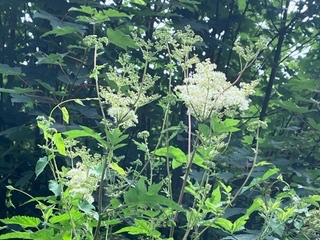
The lane had suddenly become a green and white landscape, with flowers foaming through the grasses.
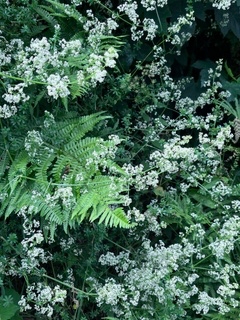
 Meadowsweet and lady’s bedstraw, both used in medieval times to scatter among the rushes and mattress fillings.
Sunday 28 June 2026
The female blackbird was only visible occasionally in the back garden as she foraged up and down in the grass. The male briefly visited one of the cutting beds, sleek and black with a tremendously vivid, almost orange, beak that blended beautifully with the dahlias flowering above him.
A small ant carrying a tiny white grain made its way across what must seem like a desert like expanse above the wall by my seat. I watched it for some time, taking what seemed to me a very circuitous route around little mounds of soil towards its nest, but I couldn’t see where it ended up among the plants edging the steps. As I watched, I realised there were several of these tiny ants, all trekking backwards and forwards along the same tortuous tracks, often crossing shallow groove which must have seemed like ravines to them, or up what must have been serious mountains as they scaled the monolithic rocks of lower walls of the back garden terraces.
Friday 26 June 2026
At first, we only seemed to have two sparrows, now we have about eight. They come not only for the feeders but for the dry patches in the flower beds where they wriggle out hollows to bathe, fluttering their wings and squirming ecstatically in a rising cloud of dust so that they are almost indistinguishable from the ground. These patches soon become pocked with little dips like a small moonscape, and the birds fly away refreshed, their feathers tidied, their parasites hopefully smothered.
Wednesday 24 June 2026
The birds still came to the feeders in large numbers in spite of the heat. But only one pigeon tried to join the throng and was as usual chased away by my dogs. They aren’t bothered by the smaller birds, but don’t like the bigger ones, like pigeons and rooks, to land in the garden. And the birds seem to tease them, perching in the silver birch or on the nearby roof ridge, staring down, waiting for an opportunity to outwit them.
But today the dogs wanted to stay on the cool terrace, out of the sun, and the solitary pigeon managed to feed on the fallen seeds and sunflower hearts for quite some time. At first, he kept behind some large pots but gradually emerged into the open and was ignored by the dogs.
Tuesday 23 June 2026
32ºC, a high pale blue sky over us as the dogs and I sheltered in the shade on the garden terrace. Very little moved, only a slight breeze occasionally flickered the leaves on the acer. There was no thud of footsteps in the lane, no sound of voices. Not a bird or butterfly moved across the garden, which lay motionless in the heat. Only a hedge sparrow sat on the fence, his back very chestnut, his head very black.
A brief blur of movement caught my eye. A hummingbird hawkmoth, unfazed by the heat, probing the pink flowers of the valerian that grows out of the wall.
A more subtle movement made me stare at the clematis that grows along the top of the wall near the acer. I briefly saw a wren, perched still in silhouette for a second.
Then all was still again.
Monday 22 June 2026
The young blackbird settled in the short grass for a while, wings spread out, beak agape, clearly trying to cool off in the tremendous heat. His father appeared later, settling in his favourite spot, the longer grass at the foot of the garden, where his black body looked just like one of the shadows that crept out from the shrubs, and was only betrayed by the bright yellow of his beak.
And the female is back. She landed on the fence beside my seat, looking very healthy with her brown speckled chest nicely rounded, unlike the male who is in much poorer condition.
Sunday 21 June 2026
The male blackbird appears alone now and looks very thin. His feathers have lost the glossy sheen they had only a week ago, and look patchy, with a grey one appearing here and there on his chest.
I haven’t seen the female for some weeks and wonder if he’s been doing the feeding of an entire brood if she’s gone missing. I’ve only seen one fledgling, so maybe that’s the only youngster to have survived.
There were several nests tucked away deep in the dense hedges of my front and back gardens – at least one blackbird’s nest in the front, two in the back. They would be hard for predators to access, but we have a rook colony nearby that could with determination get in. They probably have access to easier sources of food though, including my feeders, which they descend on in the early morning and late evening for a noisy few minutes of feasting.
Saturday 20 June 2026
As I sat outside in the sun the blackbird juvenile perched on the fence beside me. He was no longer following his father everywhere but stared at me intently for a minute or more. Maybe I’m associated with the bird feeders; it certainly felt as though he was willing me to provide him with food.
Some years ago, when I worked in a downstairs room opening onto my old garden the resident blackbird soon learned to perch on a nearby branch and stare at me until I got up to scatter mealworms for him. If I was slow on the uptake he came down to the open doorway and glared at me. One way or another I was always aware of that demanding stare drilling into me. It wasn’t long before the resident robin copied the blackbird, taking over his role if he was momentarily distracted. And soon both birds brought their fledglings to visit, so I obviously appeared on the ‘source of food’ register the youngsters were no doubt committing to memory.
Thursday 18 June 2026
Walking along Wreyland Path I paused to look over the railings into the golden waters of the Wray Brook. And there, in the shadow below the old railway bridge, dashing through the shallow waters, was a small slim fish, possibly a very young brown trout.
Wednesday 17 June 2026
A baby robin that has been keeping to the fringes of the garden for some days came out into the open today, perching on the fence beside the crowded bird feeders before flying down to pick up the fallen sunflower hearts on the ground. He’s still fluffy, with distinctive speckles on his dust-coloured chest, but growing in confidence every day, and not waiting now for a quiet moment to come to the feeders.
Tuesday 16 June 2026
Today the male blackbird didn’t have time to rest in the dust bowls created by the sparrows at the foot of my front garden. A fledgling trailed him, like a faded dusty ghost of the adult in his glossy plumage with bright yellow beak and legs. The only display of colour from the youngster was when he opened his beak to receive the offerings his parent produced. He was almost as big as his father, but still waggled his tail when food was offered, stimulating the adult’s instinct to feed him.
Wednesday 10 June 2026
I haven’t seen the usual goldfinch charms for some time. They’ve lined the nearby silver birch or clustered on the feeders with great intensity for so long that their absence is conspicuous now. But today I saw the first young goldfinch in the garden, a bundle of still fluffy feathers crouched on the terrace stones outside the garden door. It stayed there for nearly half an hour, dazed by the big world around it, but not at all bothered by the dogs playing on the lawn.
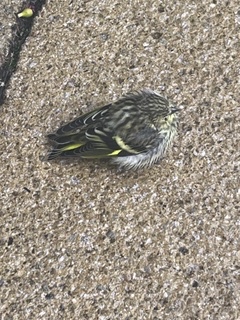
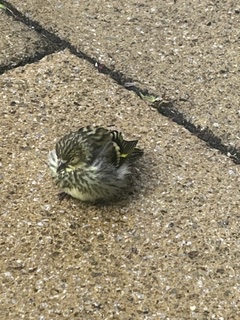
It was only when Torr, my younger collie, went indoors, totally ignoring the new visitor but carefully not stepping on it, that the fledgling took flight to perch on the fence. Newly emerged fledglings usually sit on the ground for some time on their first trip out of the nest, quite unaware of any dangers that might be lurking. I’m always relieved when they finally fly up into the trees.
Tuesday 9 June 2026
There were a pair of hart’s tongue ferns perched high on the wall under the hedge. One leaf was quite still, the other swayed like an undulating snake in a slight whisper of breeze.
Saturday 6 June 2026
Early this morning a fat fluffy young blue tit perched motionless on one of the top arches of the birdfeeder. It waited silently until a parent who looked about half its size came to feed it.
Later in the evening the woodpecker fledgling and his father both came to the feeders at the same time, although they arrived separately. As they both like the sunflower seeds the fledgling waited on the fence while his father perched on the feeder. The fledgling didn’t appear to beg for food, but the parent was soon conveying it to him and having it calmly accepted.
Friday 5 June 2026
I‘ve seen the young siskin several times now, and he’s been joined by seven other siskin fledglings. The blue tit babies are out of their nest in the wall, also quite fluffy, but eagerly clapping their wings, squeaking for food, hoping for a parent to bring it to them.
The sparrow babies are the most determined to be fed, perching next to their mother on the seed feeder tray, their beaks agape and squealing persistently. The mother ignored them and eventually one began to pick at the seeds and the other got the idea. These two fell silent but there is still an intermittent squeaking from other babies lurking in the undergrowth. The two juveniles became quite belligerent about their food and stood defensively on the rim of the tray, daring any intruders to try get in. Another bird tried to land beside them, but the only ones they let in were their sparrow parents.
Thursday 4 June 2026
I couldn’t at first work out what the bird on the feeders was with its longish white/grey body. Then I realised it was a woodpecker fledgling. It was quicker to use the feeders than most of the young birds who often seem to sit out in the garden for some time, seemingly dazed by the big open world they’ve just emerged in.
The first fledgling to appear in the garden was a siskin, which landed on the back of somebody bending over the flowers, presumably on its first flight. It went on to land properly on the grass, where it sat, fat and fluffy for some time, almost confused about where it found itself.
A little later I saw it on the flat feeding tray on the bird feeders, again standing looking as if it didn’t know what to do, completely ignored by the older birds. He must have been observing the other birds because a little later he was on the mixed seed tray, at first looking as if he didn’t know what to do, but then beginning to peck at the seeds in the tray and gradually movinf onto the feeder itself.
Tuesday 2 June 2026
As I sat on one of the benches in front of the village shop, I noticed a splash of colour under the dark blue body of the pickup parked opposite. It was a robin perched on top of the tyre under the high wheel arch.